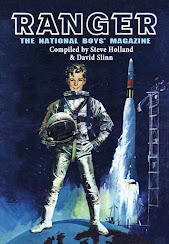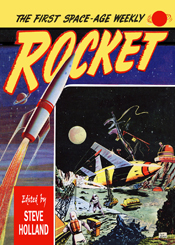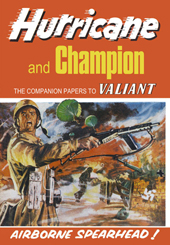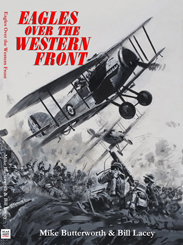

(* Ben Hur artwork © Look and Learn Ltd. Reprinted by permission.)

(* Ben Hur artwork © Look and Learn Ltd. Reprinted by permission.)
"... but you're right about the boffins. They say the earth is shrinking at the poles. That makes it feasible that it will bulge in the middle, doesn't it? I can't visualise how that affects us, but I do understand that it slows up the earth's revolutions. That could be important."From scientists (sorry, boffins) predicting the destruction of Earth to memories of a miserable camping trip in one easy paragraph. But even this kind of bad writing has a certain charm to it (well, I think it has charm) and makes you wonder if the author hasn't misremembered something he's heard about global warming and shrinking ice caps (and this way back in 1962).
__Paul Duffy grinned. "Just shows you how much we depend on the Sun, doesn't it? Though last summer he must have taken his holidays the same time as I had mine!" He closed his eyes thoughtfully. "God! That camping business!"
"Gavin, old man. What about trying another look-see out of the window? Might be something new."They reach Earth, parachuting out of the rocket to land on an atoll that appears to have suffered the effects of an atomic bomb blast. Eventually, Don discovers that the Maruans have invaded for that time-honoured reason: they need to steal some women:
"The Maruan women, for some time, had been given all the privileges of men. They were equal, they had the same rights. Of course they bore that children; that was the catch ... The women rebelled against what they called 'the servility of child-bearing'. It was a farcical situation, and executing them had not made matters any better..."...says Don. Before we descend completely into misogynistic claptrap, I will say that the paperbacks of the era were full of this kind of casual sexism, although few go quite as far as executing feminists. Actually, the book has lost its charm long before that point and starts to drag after the first 20 or so pages. But it does have a surprisingly down-beat ending for this kind of pulp writing; the books usually end with the hero and his girl looking forward to a bright future. In The Maru Invasion, it's as if the author suddenly remembered the cover and thought he'd better write in an explanation for it. Thus we have a silver alien spaceship approaching the hiding place of a small group of earthmen on the nuclear blasted surface of an atoll and Don's final words are: "Well, here they come, the bastards!"
__"That's where you made you mistake, old boy! We've never let our women know that they were our equals!"
He leapt back as a wide jet of crimson flame scorched forth from the blunt barrel, hitting Argos full in the face. There was a loud, inhuman scream. The others were transfixed with terror, but Don could take no chances and turned the gun on them as they stood there, eyes stark with fear. Flame belched again and they fell to the ground, their hands clawing at their faces and throats...
Lanny stood still, his eyes glued on that crumpled form by his feet. He wanted to run back downstairs, to safety and sanity, but he had to know what it was. He stopped to examine the upturned face and gasped, in horror, as the ghastly picture fixed itself in his mind...
__It was a woman. A woman with blonde, wavy, luxuriant hair. Hair that was matted with dark, red, glistening substance. Blood. Across the face which had once been beautiful, there ran a gaping wound, filled with congealed blood. He put his hand out to turn the poor bruised head towards him, and, as he did so, the whole face seemed to slide sideways, as it it were some dreadful, artificial mask.
The ominous, leaden sky brooded threateningly over the earth: the sultry heat became daily more stifling. What was the cause of these oppressive clouds which came ever closer and for which the scientists could hazard no explanation? Then it came, a blinding, havoc-wreaking death storm: relentless, tearing rain and the earth's surface gouged with craters, shattered beyond recognition...
__A small party of survivors find themselves on an alien planet, hurled there by the cosmic force of the earth's upheaval. Can they ever escape from this bleak world with its stern silent inhabitants? Their plans are dependent on a second even more violent nuclear storm, and they are flung once more into a hostile universe—to safety? or total destruction?
A party of scientists have been sent on a mysterious journey to Tibet. None of them knows why.As I mentioned above, I've been planning an occasional series on unresolved mysteries concerned with my research into old British paperbacks and Luan Ranzetta was going to be one of the subjects as I'd managed to pick up the set (I'm ignoring V. Ranzetta for the moment).
__As they step from their space-ship none of them could be aware of the terrifying dangers that lay ahead.
__They must prevent the sinister Doctor Chung-Yin from carrying out his threat to destroy the entire Western World. Either they are successful, or they die a horrible death themselves.
Last Sunday's trip up to the ABC Show was the usual tale of travel woes—this time we ended up in Newbury Park via bus from Ingatestone; better than the show last March where we were diverted to Basildon, I guess, but still annoying when you've paid for a service that the railways just can't seem to provide.
Work is progressing on the Eagles Over the Western Front volumes. Mostly artwork cleaning, although that came to a grinding halt when my glasses broke (the tiny little screw holding the glass in place, this time, rather than the arm falling off, just for variation). I've a second pair, but they're for travel rather than reading, so not much help with close-up work. I did learn at the show of another two pages of original Eagles artwork that have survived the years, so we're now up to 57 pages that will be reproduced from Bill Lacey's original drawings.
Cities of the Dead is a novel of the future, but the message it holds could apply equally well to the present day. A series of nuclear tests in the Pacific Ocean have affected certain species of sea creatures, with the result that they grow to more than ten times their original size. People living on the western seaboard of America are terrorised by these hideous leviathan-like monsters and a group of scientists are dispatched to the area to exterminate this menace to civilisation.Although credited to Peter Edgar, Cities of the Dead was the debut novel of Peter King-Scott, an engineer by profession. Born Peter Edgar King Scott on 8 September 1918, he officially changed his name to King-Scott in 1943. He served as a Captain with the Worcestershire Regiment and as an intelligence officer during the war and returned to industry in 1946, later becoming a full-time lecturer in engineering and management subjects. In partnership with his wife, Margaret P. (nee Stonham), he also ran a small management-consultancy business.
It's hard for me to believe that Battle Picture Weekly first debuted almost 35 years ago. To me it still feels like something that happened, if not the other day, at least fairly recently. It wasn't until the early '80s that I became a regular reader after I rediscovered comics following a roughly seven year gap (although, as I've said many time before in these columns, I never really gave up because there was always some comic—Top Secret Picture Library, Starblazer, etc.—that I was buying). Battle I caught up with via a massive boot fair find and it was an incredible thrill to be reunited with some of my favourite artists doing some of the best work they'd ever done: Mike Western on "Darkie's Mob", "The Sarge" and "HMS Nightshade", Eric Bradbury on "Joe Two Beans" and "Crazy Keller", and Joe Colquhoun on "Johnny Red" and "Charley's War". And there was a ton of other stories that I found incredibly gripping as I read through episode after episode: the Mike Nelson stories ("Day of the Eagle", "Death's Head Dossier", etc.), "Major Eazy", "Fighting Mann", "Deathsquad", "Clash of the Guards", and many others. Gaps in the run were cursed soundly because I didn't want to miss a beat.
The Best of Battle selects 18 strips from Battle's heyday, the late 1970s. The format—extracting four or five episodes from strips that sometimes ran for years—can be a little frustrating, although at least with extracts of 12 to 15 pages you get more out of the stories than in the recent Best of Battle special released by Egmont. It's still only a sampler for the books we all actually want, but it's at least a substantial sample.
The simplified credits given in the book mean that one or two writers and artists don't get a mention: the first episode of "D-Day Dawson" was drawn by Annibale Casabianca, the second, third and fourth reprinted here were by Geoff Campion and only the fifth was drawn by the credited artist, Colin Page; three of the five were written by Wagner/Mills rather than the credited Gerry Finley-Day. But the occasional glitch is to be expected in any book.
(* Artwork © Egmont UK Ltd.)